Hunting for
shadows.
A two-stage neural network was trained to vet TESS planet candidates from folded light curves, then tested on unseen observations from a later catalogue snapshot.
A stricter second look at possible planets.
The project asks whether shape alone is enough, or whether a second stage of physical diagnostics can reject more convincing false alarms.
The question
Test whether a diagnostic second stage can reduce accepted false positives on observations from a newer TESS catalogue snapshot.
The approach
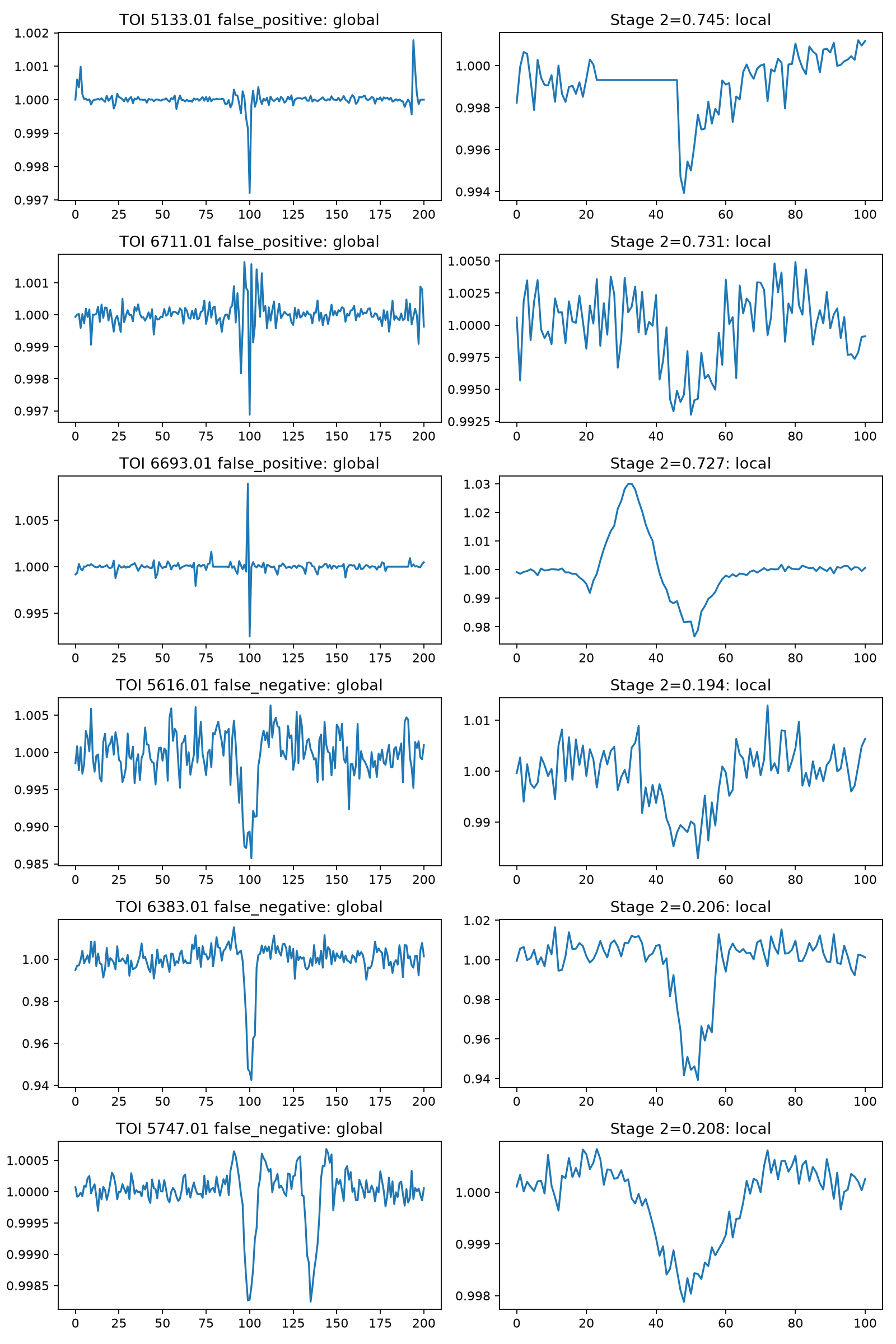
A two-view CNN reads global and transit-window light curves. Stage 2 adds period, depth, duration, BLS strength, odd/even differences and secondary-eclipse evidence.
The result
false positives
False-positive rate fell from 0.604 to 0.486. Recall also fell from 0.851 to 0.716, so the improvement comes with a real temporal-generalisation trade-off.
Glossary
- Transit
- A small, temporary dimming when a planet crosses in front of its star.
- Light curve
- A record of how a star's measured brightness changes over time.
- False positive
- A signal that resembles a planet transit but has another cause.
- TOI
- A TESS Object of Interest: a signal selected for closer investigation.
- BLS
- Box Least Squares, a search for regularly repeating, transit-shaped dips.
- Recall
- The share of catalogue planets the model successfully keeps.